
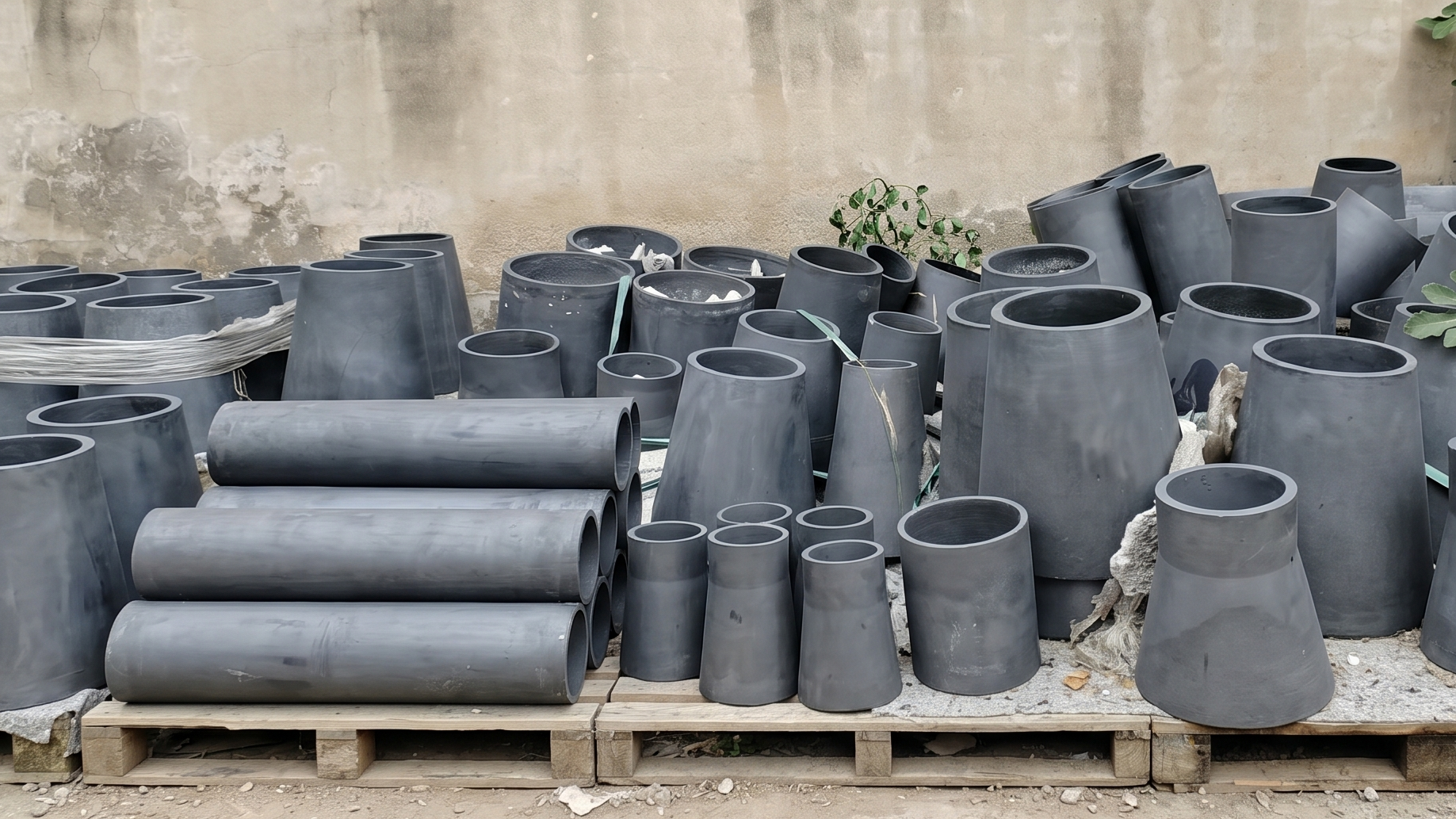
Silicon Carbide (SiC) Ceramic Products
WearTech silicon carbide ceramic products deliver unmatched performance where alumina ceramics reach their limits — in extreme temperatures (up to 1600°C), aggressive chemical environments, and ultra-high abrasion. With Mohs hardness 9+ and thermal conductivity 3–5× higher than alumina, SiC ceramics extend service life 5–7× longer than alumina in the most demanding applications. All products are custom-manufactured to your specifications.
Why Silicon Carbide?
SiC ceramics are fundamentally different from alumina. The strong covalent Si–C bond (88% covalent character) creates a material that retains full mechanical strength at temperatures where metals creep and alumina softens. Combined with exceptional thermal shock resistance, SiC is the material of choice when both extreme wear and extreme temperature are present.
- Extreme Hardness — Mohs 9+, Vickers 2200–2800 HV; 50% harder than tungsten carbide, 10× harder than stainless steel
- High Thermal Conductivity — 40–170 W/m·K (3–5× alumina), enables efficient heat dissipation and outstanding thermal shock resistance
- Low Thermal Expansion — CTE 4.0–5.0 × 10⁻⁶/K (half of alumina), minimizes thermal stress during rapid temperature cycling
- Superior Corrosion Resistance — Virtually inert to all acids, alkalis, and organic solvents except HF; annual corrosion rate below 0.01 mm in boiling 98% H₂SO₄
- High‑Temperature Strength Retention — Maintains 400+ MPa flexural strength at 1400°C; no creep below 1600°C
- Lightweight — Density 3.0–3.2 g/cm³ (1/3 of steel), reduces structural load and handling cost
SiC Ceramic Mosaic Tiles — Custom Engineered for Your Equipment
Our flagship SiC product line. WearTech SiC mosaic tiles are precision‑manufactured interlocking tiles designed to line the most severely worn surfaces in your equipment — curved pipes, elbows, cyclones, chutes, and hoppers. Unlike standard alumina mosaics, SiC mosaics deliver superior thermal shock resistance and chemical inertness, making them the ideal choice for high‑temperature, high‑impact, and chemically aggressive environments.
- Fully Customizable — Tile size, shape, thickness, and SiC grade tailored to your specific equipment geometry and operating conditions
- Interlocking Design — Hexagonal, square, and custom shapes with precision edges for gap‑free coverage
- Multiple SiC Grades — RBSiC for complex shapes and thermal shock; SSiC for maximum wear and corrosion resistance; NBSiC for cost‑effective high‑temperature applications
- Versatile Installation — Adhesive bonding, mechanical anchoring (welded studs), or rubber‑backed composite mounting for impact‑prone areas
- Proven Results — 5–10× service life vs. alumina mosaic in thermal cycling applications; near‑zero maintenance in continuous operation
Three SiC Manufacturing Processes
WearTech offers silicon carbide ceramics in three primary grades, each delivering a distinct balance of performance, cost, and application suitability:
Reaction‑Bonded SiC
(RBSiC / SiSiC)
- Liquid silicon infiltrates carbon/SiC preform at 1450–1700°C
- Contains 8–25% free silicon as secondary phase
- Near‑net‑shape capability — less than 1% shrinkage, ideal for complex geometries
- Excellent thermal shock resistance
- Max service temp: 1350–1400°C (limited by free Si)
- Best for: wear liners, mosaic tiles, seals, nozzles, kiln furniture
- 30–50% lower cost than SSiC for equivalent geometries
Sintered SiC
(SSiC)
- High‑purity SiC powder sintered at 2000–2500°C with minimal aids
- Greater than 98% SiC purity, near‑zero porosity
- Superior hardness, corrosion resistance, and high‑temp stability
- Max service temp: 1600–1900°C (in air)
- Best for: mechanical seals, pump parts, chemical process equipment, semiconductor fixtures
- Highest cost but longest service life in extreme conditions
Nitride‑Bonded SiC
(NBSiC)
- SiC grains bonded by silicon nitride (Si₃N₄) matrix
- Contains 70–85% SiC with Si₃N₄ bonding phase
- Excellent oxidation resistance at 1300–1500°C
- Good thermal shock resistance, lower thermal conductivity
- Max service temp: 1450–1500°C
- Best for: kiln furniture, shelf boards, setter plates, refractory components
- Most economical SiC grade for high‑temperature applications
Technical Data — Three Grades Comparison
All values based on standard test specimens; actual properties may vary with geometry and formulation. Data cross‑validated from Saint‑Gobain Hexoloy TDS, Kyocera, CAGTIC, and 7+ Chinese SiC manufacturers.
| Parameter | RBSiC / SiSiC | SSiC | NBSiC | Unit |
|---|---|---|---|---|
| SiC Content | 75–92% | Greater than 98% | 70–85% | % |
| Free Silicon | 8–25% | Trace | 0 (Si₃N₄ bond) | % |
| Bulk Density | 3.00–3.10 | 3.10–3.20 | 2.60–2.75 | g/cm³ |
| Mohs Hardness | 9 | 9+ | 9 | — |
| Vickers Hardness (HV) | 2200–2600 | 2500–2800 | 1800–2200 | HV |
| Flexural Strength | 250–400 | 400–550 | 150–250 | MPa |
| Compressive Strength | 1800–2200 | 2200–3900 | 800–1200 | MPa |
| Fracture Toughness | 3.5–4.5 | 3.5–4.6 | 2.5–3.5 | MPa·m¹/² |
| Elastic Modulus | 330–410 | 410–430 | 200–280 | GPa |
| Thermal Conductivity (RT) | 110–170 | 110–130 | 40–60 | W/m·K |
| CTE (20–1000°C) | 4.0–5.0 | 4.0–4.5 | 4.5–5.5 | ×10⁻⁶/K |
| Thermal Shock Resistance (ΔT) | Greater than 350 | Greater than 400 | Greater than 300 | °C |
| Max Service Temp. (Air) | 1350–1400 | 1600–1900 | 1450–1500 | °C |
| Water Absorption | Less than 0.1% | Less than 0.1% | 10–15% | % |
| Corrosion Resistance | Good | Excellent | Moderate | — |
SiC vs Alumina — When to Choose SiC
Alumina ceramics offer excellent wear resistance at a lower price point, but SiC ceramics are the superior choice when operating conditions include extreme temperatures, rapid thermal cycling, or highly corrosive media:
| Property | SiC (SSiC) | Alumina (95% Al₂O₃) | SiC Advantage |
|---|---|---|---|
| Wear Life | 5–7× baseline | Baseline | Dramatically longer equipment uptime |
| Thermal Conductivity | 110–130 W/m·K | 20–35 W/m·K | 3–5× higher, better heat dissipation |
| Max Working Temperature | 1600°C+ | 1500°C (solid) / 350°C (lined) | Far higher continuous service temp |
| Hardness (Knoop) | 2500–2800 | 1500–1650 | ~70% harder, superior wear resistance |
| CTE | 4.0–4.5 ×10⁻⁶/K | 7–8 ×10⁻⁶/K | ~50% lower, better thermal shock |
| Corrosion Resistance | Excellent (near‑universal) | Good (except HF, hot H₃PO₄) | Better in strong acids and alkalis |
| Thermal Shock (ΔT) | Greater than 400°C | 200–300°C | Survives more extreme cycling |
Product Specifications
SiC Mosaic Tiles (Standard & Custom)
Small‑format interlocking tiles for curved and complex surfaces. Can be pre‑assembled into mats for rapid installation.
| Shape | Size (mm) | Thickness (mm) | Typical Application |
|---|---|---|---|
| Square / Hex Mosaic | 10 × 10 | 1.5–10 | Small pipe elbows, tight curves |
| Square / Hex Mosaic | 12 × 12 | 3–12.7 | Cyclone interiors, standard curves |
| Square / Hex Mosaic | 17.5 × 17.5 | 4–10 | Medium‑radius elbows |
| Square / Hex Mosaic | 20 × 20 | 5–15 | Pipe bends, chutes |
| Square / Hex Mosaic | 25 × 25 | 5–15 | Large‑radius elbows, hoppers |
Custom SiC Mosaic Tiles Available — Send us your equipment drawings and operating conditions. We design and manufacture mosaic tiles to any shape, size, and thickness specification, including trapezoid, parallelogram, and curved tiles for specific pipe diameters.
SiC Plain Tiles & Plates
For flat and gently curved surfaces. Installed via epoxy adhesive or mechanical fastening.
| Shape | Size (mm) | Thickness (mm) | Typical Application |
|---|---|---|---|
| Rectangle | 50 × 25 | 5–10 | Narrow surfaces, transitions |
| Square | 50 × 50 | 5–15 | Flat and mildly curved areas |
| Square | 100 × 100 | 6.5–15 | Large flat areas, straight pipes |
| Rectangle | 150 × 100 | 12–100 | Chute walls, bin liners |
| Rectangle | 200 × 100 | 25–100 | Heavy‑duty lining |
| Square | 300 × 300 | 25–100 | Maximum‑area flat protection |
SiC Pipe Tiles (Curved Segments)
Pre‑formed curved tiles matching specific pipe inner diameters for a precise fit with minimal gaps.
| Spec (mm) | Applicable Pipe Diameter | Thickness (mm) |
|---|---|---|
| 150 × 31/35 × 12 | DN200–DN250 | 12 |
| 150 × 39/42 × 12 | DN250–DN300 | 12 |
| 150 × 50/53 × 12 | DN300–DN350 | 12 |
| 150 × 27/35 × 25 | DN200–DN250 | 25 |
| 150 × 36/42 × 25 | DN250–DN300 | 25 |
Pipe tiles custom‑manufactured to match your exact pipe specifications (DN100 to DN1200+).
SiC Pipes & Fittings
Complete silicon carbide piping components for extreme wear and corrosion environments:
| Parameter | RBSiC | SSiC | Unit |
|---|---|---|---|
| Available Sizes (DN) | DN50–DN500 | DN50–DN300 | mm |
| Wall Thickness | 5–25 | 5–20 | mm |
| Max Custom Length | 2500 | 1500 | mm |
| Connection Type | Flanged / Butt‑weld / Socket | Flanged / Socket | — |
| Max Service Temperature | 1350 | 1600 | °C |
| Flexural Strength | Greater than 300 | Greater than 400 | MPa |
| Thermal Conductivity | 110–170 | 110–130 | W/m·K |
Custom SiC Components
Beyond standard tiles and pipes, WearTech provides fully custom SiC ceramic components for specialized applications:
SiC Elbows & Bends
One‑piece sintered or assembled from curved segments. 30–180° angles, bend radius R=50–R=2000 mm.
SiC Tees & Reducers
Available in RBSiC and SSiC grades. Standard and custom configurations.
SiC Cyclone Liners
Precision‑formed cone and cylinder segments for hydrocyclones — vortex finders, spigots, barrel sections.
SiC‑Rubber Composite Panels
SiC tiles vulcanized into wear‑resistant rubber matrix with optional steel backing. Absorbs impact energy while maintaining wear resistance — ideal for ore chutes and slurry lines.
SiC‑Metal Composite Pipes
SiC lining bonded within steel pipe for combined wear resistance and structural strength.
SiC Kiln Furniture
Shelf boards (up to 600×400 mm), beams (up to 2500 mm), setters, saggers, and support pillars. RBSiC and NBSiC grades for 1350–1500°C continuous operation.
Industry Applications
WearTech SiC ceramic products serve the most extreme operating environments across major industries:
Mining & Mineral
Slurry pipes, cyclone liners, ore chutes, tailings lines
Power Generation
Boiler nozzles, ash conveying, FGD slurry loops, hot gas ducts
Chemical Processing
Acid/alkali pipes, reactor linings, heat exchangers
Steel & Metallurgy
Blast furnace pipes, slag handling, thermocouple tubes
Cement
Clinker conveying, mill discharge chutes, cyclone separators
Ceramics & Glass
Kiln furniture, setter plates, refractory components
SiC Product Selection Guide
Choosing the right silicon carbide product depends on your operating conditions, performance requirements, and budget:
- Temperature — Below 1350°C: RBSiC (cost‑effective); Above 1350°C: SSiC (no free Si limit); Kiln furniture up to 1500°C: NBSiC (best value)
- Corrosive Media — Strong acids/alkalis: SSiC (zero free Si); Moderate corrosion: RBSiC; Oxidizing atmosphere at 1300–1500°C: NBSiC
- Thermal Cycling — Rapid heating/cooling (ΔT greater than 300°C): RBSiC (free Si improves crack resistance); Gradual changes: SSiC or NBSiC
- Geometry — Complex shapes (thin walls, channels): RBSiC (near‑net‑shape); Simple precision parts: SSiC (diamond‑machined tight tolerances)
- Mosaic Tiles — Thermal shock environment: RBSiC; Maximum wear/corrosion: SSiC; Impact‑prone areas: RBSiC with rubber backing
- Budget — Cost‑sensitive high‑temp: NBSiC; Best all‑round: RBSiC; No‑compromise extreme conditions: SSiC
- Custom Requirements — All three SiC grades support full customization of dimensions, shapes, and surface finish. Contact our engineering team for application‑specific recommendations.