Rubber Ceramic Composite Panels

Impact Resistant Ceramic-Rubber Hybrid Linings for Severe Wear Applications

Impact & Abrasion | Modular System | Easy Installation

⚙️

Looking for ceramic rubber composite lining that combines the hardness of alumina ceramic with the elasticity of rubber for ultimate wear protection? As a trusted ceramic rubber wear liner manufacturer, WearTech delivers dual-action defense — ceramic tiles for abrasion resistance, rubber matrix for impact absorption — in one integrated panel.

Two-in-One: Ceramic + Rubber — Our rubber backed ceramic liner plate features alumina tiles hot-vulcanized into a rubber matrix via CN bonding layer. Adhesive-bonded to equipment surfaces. Flexible, lightweight, and can be twisted or cut on-site to fit irregular geometries. Working temperature: –50°C to 100°C. Best for moderate impact conditions in chutes, pipes, and tanks.

Three-in-One: Ceramic + Rubber + Steel — Our premium three in one ceramic rubber steel lining bonds the ceramic-rubber panel to a Q235A steel backing plate with welded studs. Bolt-on or weldable installation — no adhesive needed. Rigid structure with maximum impact protection. Working temperature up to 250°C with heat-resistant rubber compound. Quick bolt-on replacement reduces downtime to minutes.

Technical Parameters: Alumina ceramic tiles (92%–99% Al₂O₃, ZTA, SiC) hot-vulcanized through CN bonding layer. Ceramic-rubber adhesion ≥3.8 MPa. Rubber aging resistance ≥15 years. Available in panel sizes from 250×250mm to 600×450mm with ceramic thickness 4–50mm and rubber thickness 5–20mm. Tile shapes: square, hexagonal SW, cylinder, and custom rectangle.

Our Advantage: 15+ years manufacturing impact resistant ceramic rubber lining panels. ISO 9001 certified, annual capacity 15,000+ tons. Custom cutting, profiling, and drilling to match your exact equipment dimensions. OEM packaging available. Shipping to 40+ countries within 7–30 working days.

Our Ceramic Rubber Composite Lining Product Range
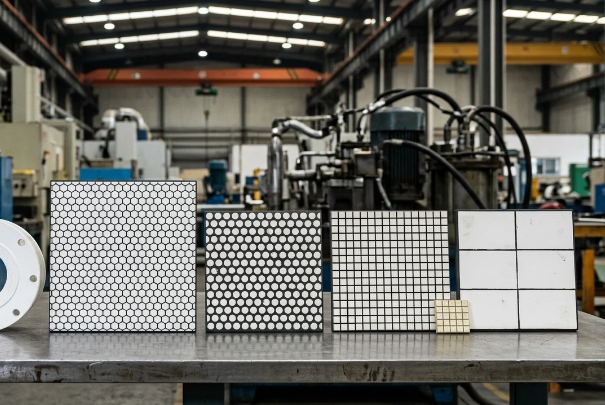
Ceramic Rubber Composite Lining Panel - Impact Resistant Wear Protection

Ceramic Rubber Composite Lining Panels - Hexagonal and Square Ceramic Tiles Embedded in Rubber Matrix with Steel Backing for Mining Equipment Wear Protection

Series 1: Two-in-One Ceramic + Rubber — Rubber Backed Ceramic Liner Plate

Our Two-in-One rubber backed ceramic liner plate features high-alumina ceramic tiles hot-vulcanized into a premium rubber matrix through CN bonding layer. Adhesive-bonded directly to equipment surfaces — flexible, lightweight, and can be twisted or cut on-site to fit pipes, cyclones, and irregular geometries. Working temperature: –50°C to 100°C. The most cost-effective ceramic rubber composite lining solution for moderate impact conditions.

Parameter Specification
Structure Ceramic + Rubber (Two-in-One)
Installation Adhesive bonded
Ceramic Thickness 4–50 mm
Rubber Thickness 5–20 mm
Working Temperature –50°C to 100°C
Rubber-to-Equipment Adhesion ≥3.5 MPa
Ceramic-Rubber Adhesion ≥3.8 MPa
Best For Chutes, pipes, tanks, moderate impact

Series 2: Three-in-One Ceramic + Rubber + Steel — Impact Resistant Ceramic Rubber Lining

Our premium three in one ceramic rubber steel lining bonds the ceramic-rubber panel to a Q235A steel backing plate with welded studs. Bolt-on or weldable installation — no adhesive needed. Rigid structure delivers maximum impact protection. The impact resistant ceramic rubber lining design allows quick bolt-on replacement, reducing downtime to minutes. Working temperature up to 250°C with heat-resistant rubber compound. The most secure option for critical wear zones.

Parameter Specification
Structure Ceramic + Rubber + Steel (Three-in-One)
Installation Bolt-on or welded via steel studs
Steel Plate Thickness 3–8 mm (Q235A)
Ceramic Thickness 4–50 mm
Rubber Thickness 5–20 mm
Working Temperature –50°C to 250°C (heat-resistant)
Replacement Time Minutes (bolt-on design)
Best For Crusher discharge, transfer points, high impact

Series 3: Ceramic Tile Grades — Five Options for Every Demand

Our ceramic rubber wear liner panels feature high-purity alumina ceramic tiles, ZTA, and silicon carbide tiles in multiple grades. Available tile shapes include cylinders, squares, rectangles, and hexagonal "SW" specifications — all vulcanized into rubber through CN bonding layer for permanent integration.

Parameter 92% Al₂O (WT-CR92) 95% Al₂O₃ (WT-CR95) 99% Al₂O₃ (WT-CR99) ZTA (WT-CRZTA) SiC (WT-CRSiC)
Al₂O₃ / SiC Content ≥92% ≥95% ≥99% Al₂O₃+ZrO₂≥92% SiC≥90%
Bulk Density (g/cm³) ≥3.60 ≥3.65 ≥3.80 ≥3.70 ≥3.00
Rockwell Hardness ≥82 HRA ≥85 HRA ≥88 HRA ≥85 HRA ≥85 HRA
Bending Strength (MPa) ≥220 ≥250 ≥300 ≥280 ≥250
Compressive Strength (MPa) ≥1050 ≥1300 ≥1500 ≥1500 —
Fracture Toughness (MPa·m¹/²) ≥3.70 ≥3.80 ≥3.50 ≥4.80 —
Max Working Temp (°C) 100 100 100 100 1380

Series 4: Rubber Layer & Steel Backing Technical Data

Premium rubber formulation ensures long-lasting elasticity and strong bonding with ceramic tiles through hot vulcanization. Both natural rubber and nitrile-butadiene rubber (NBR) compounds are available. The steel backing plate (Three-in-One only) provides structural rigidity and enables bolt-on or welded installation of your ceramic rubber composite lining.

Parameter Standard Rubber (NR/NBR) Heat-Resistant Rubber Steel Backing (Three-in-One)
Density (g/cm³) 1.4 1.4 7.85 (Q235A)
Tensile Strength (MPa) ≥10.6 ≥10.6 ≥375
Elongation at Break (%) ≥350 ≥300 —
Shore Hardness 60±5 HA 48–58 HA —
Ceramic-Rubber Adhesion (MPa) ≥3.8 ≥3.8 —
Working Temperature –50 to 100°C –50 to 250°C –20 to 350°C
Aging Life ≥15 years ≥15 years —
Thickness 5–20 mm 5–20 mm 3–8 mm

Ceramic Rubber Composite Lining Selection Guide

Choose the right ceramic rubber composite lining configuration based on your operating conditions. As your trusted ceramic rubber wear liner supplier:

  • Moderate impact + cost priority: Two-in-One with 92% Al₂O₃ square tiles — best value rubber backed ceramic liner plate
  • High impact + secure mounting: Three-in-One with 95% Al₂O₃ tiles — bolt-on three in one ceramic rubber steel lining for maximum reliability
  • Severe impact + heavy material: Three-in-One with ZTA tiles — highest fracture toughness impact resistant ceramic rubber lining
  • Chemical corrosion + high purity: 99% Al₂O₃ tiles — maximum chemical and wear resistance
  • High temperature (above 250°C): SiC tiles with heat-resistant rubber — thermal shock resistance up to 1380°C
  • Complex geometry equipment: Two-in-One panels — flexible and cuttable to fit pipes, cyclones, and irregular surfaces

Why Choose Our Composite Panels

Dual Protection

Combines 92% alumina ceramic for abrasion resistance with rubber impact absorption. Superior to outperform pure ceramic or rubber solutions.

Vibration Damping

Rubber matrix absorbs impact energy and vibration, preventing ceramic fracture and extending service life 8-12 times rubber only.

Modular Design

Interlocking panel design with multiple fastening options. Quick installation with minimal downtime for liner replacement.

Custom Profiling

Can be custom molded to curved surfaces, pipe IDs, irregular geometries. Custom shapes and cutouts to match your exact equipment dimensions.

Frequently Asked Questions
Ceramic Rubber Composite Panels — Quick Answers
What is the difference between your two-in-one and three-in-one ceramic rubber composite panels?
The two-in-one panel bonds alumina ceramic tiles into a rubber matrix (ceramic + rubber) and is glued to the equipment — flexible and cuttable, for moderate-impact chutes, pipes and tanks. The three-in-one panel adds a Q235A steel backing plate with welded studs (ceramic + rubber + steel) and is bolted or welded on — rigid, for high-impact zones such as crusher discharge and transfer points, with replacement in minutes.
Which one should I choose for my application?
Choose two-in-one for moderate impact, irregular or curved surfaces and where adhesive bonding is practical (working temperature –50°C to 100°C). Choose three-in-one for heavy impact, high wear and high-temperature areas up to 250°C, or where you need bolt-on mounting without adhesive. Tell us the equipment, impact level and temperature and we will recommend.
What ceramic grades and panel sizes are available?
We use 92%, 95% and 99% alumina, ZTA and silicon carbide tiles, in square, hexagonal (SW), cylindrical or custom shapes. Standard panels range from 250×250 mm to 600×450 mm, with ceramic 4–50 mm and rubber 5–20 mm; sizes and cut-outs can be customized to your equipment.
How well does the composite resist impact and wear, and how is it different from pure ceramic?
The ceramic tiles resist sliding abrasion while the rubber absorbs impact energy and dampens vibration, so the panel tolerates heavy impact that could crack pure ceramic — typically giving far longer service life than rubber-only liners. The hot-vulcanized ceramic–rubber bond reaches about 3.8 MPa and the rubber is rated for 15+ years of aging life.
How are the panels installed and replaced?
Two-in-one panels are adhesive-bonded and can be cut or twisted on site to fit curves. Three-in-one panels bolt on or weld via the steel studs, with no adhesive; worn panels are unbolted and replaced in minutes, greatly reducing downtime. We can also advise on fixing layout for your equipment.
What is the MOQ, lead time and packaging?
MOQ is flexible for both trial and bulk orders. Standard panels can be produced quickly; custom sizes, shapes or grades are confirmed per drawing. Panels are packed on pallets with OEM/custom packaging available. Send us your dimensions, grade and quantity for an exact quotation and schedule.

Ready to Improve Your Grinding Efficiency?

Contact our engineering team for customized grinding media solutions tailored to your specific application requirements. Get expert recommendations and free sample testing.

Free Technical Consultation
Custom Specifications
Fast Global Shipping